
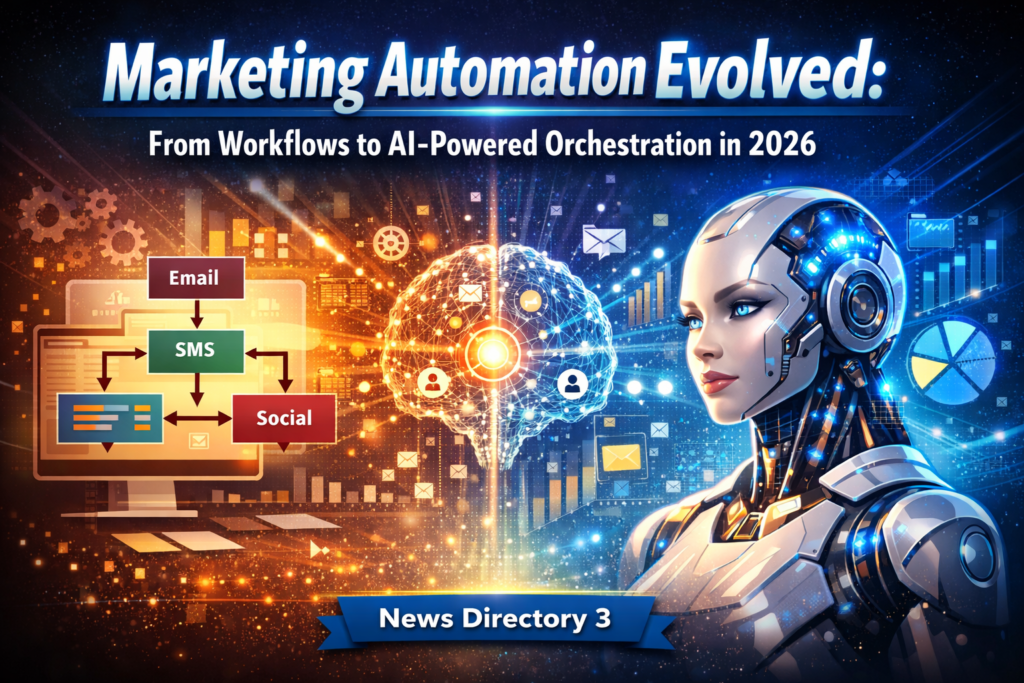
The marketing landscape in 2026 has reached a transformative milestone. What began as simple automated workflows—emails triggered by clicks, messages sent on schedule—has now matured into AI-powered orchestration: a system that doesn’t just automate marketing but intelligently adapts, predicts, and personalizes every customer experience in real time.This evolution marks a new era where data, creativity, and artificial intelligence intersect to redefine what it means to connect with audiences.
From Workflows to Intelligence: A Quick Look Back
In the early 2010s and 2020s, marketing automation tools like HubSpot, Marketo, and Mailchimp revolutionized campaign management. They streamlined repetitive tasks, nurtured leads, and aligned sales and marketing teams through predefined workflows.
However, traditional automation had a limit—it followed rules, not context. If a customer clicked a link, they entered a workflow. If not, they were forgotten until the next campaign. These rigid sequences couldn’t adapt to rapidly shifting customer behavior or intent.Enter AI orchestration, the next phase where automation is no longer static—it’s dynamic, predictive, and self-learning.

AI-Powered Orchestration: The 2026 Game Changer
In 2026, marketing automation isn’t just about efficiency—it’s about orchestration, where AI coordinates every channel, message, and moment to create seamless experiences across the entire customer journey.
Here’s how it’s reshaping the game:
- Predictive Engagement
AI models analyze past interactions, purchase history, and behavioral signals to predict what a user wants next. Instead of waiting for a click, the system anticipates the next best action—whether it’s an email, a personalized ad, or a chatbot conversation. - Dynamic Personalization at Scale
Every customer touchpoint—web pages, emails, or app interfaces—is personalized in real time. AI tools like Adobe Sensei or Salesforce Einstein use deep learning to tailor content not just by segment but by individual preference. - Omnichannel Coordination
Gone are the days of siloed campaigns. AI orchestration aligns communication across channels—email, social, SMS, and even virtual assistants—ensuring that customers receive a unified and contextual experience. - Continuous Optimization
Machine learning algorithms don’t just execute campaigns—they learn from outcomes. AI analyzes open rates, conversions, and sentiment to refine strategies automatically, keeping performance consistently high without manual adjustments.

The Strategic Edge: Marketers as Conductors, Not Operators
As automation grows more intelligent, marketers are shifting from manual executors to strategic conductors.
Instead of spending hours building sequences, they now focus on creative strategy, data ethics, and brand storytelling—areas where human insight is irreplaceable.
AI handles the execution, timing, and personalization; humans set the vision, voice, and values.
Smart marketing teams in 2026:
- Use AI dashboards to visualize campaign health in real time.
- Deploy natural language prompts to instruct automation tools (“Target users who abandoned carts in the last 48 hours with a free shipping offer”).
- Integrate predictive analytics to forecast campaign ROI before launch.
This human-AI partnership represents the future of digital marketing—precision and creativity working in harmony.
Challenges and Ethical Frontiers
While AI-powered orchestration brings incredible advantages, it also raises new questions about privacy, transparency, and bias.
Consumers expect personalization, but not intrusion. Hence, responsible marketers are building systems that prioritize data consent, explainable algorithms, and ethical targeting.
The future of marketing automation will rely not only on smarter machines but also on smarter governance.
Looking Ahead: Marketing in Motion
The year 2026 is witnessing the complete redefinition of marketing automation. We’ve moved from “set and forget” workflows to real-time orchestration—a world where AI manages complexity, and marketers master creativity.This evolution is not the end of automation—it’s its renaissance.
The most successful brands will be those that harness AI not to replace human marketers, but to amplify their intelligence, empathy, and imagination.
Conclusion
Marketing automation has evolved from simple workflows into an intelligent ecosystem powered by AI.
As orchestration platforms continue to advance, the future of marketing lies in the perfect blend of automation, analytics, and authenticity.In 2026, the question isn’t whether to use AI—but how creatively and responsibly you can orchestrate it to turn every customer journey into a meaningful, memorable experience.