
Marketing Automation Evolved: From Workflows to AI-Powered Orchestration in 2026
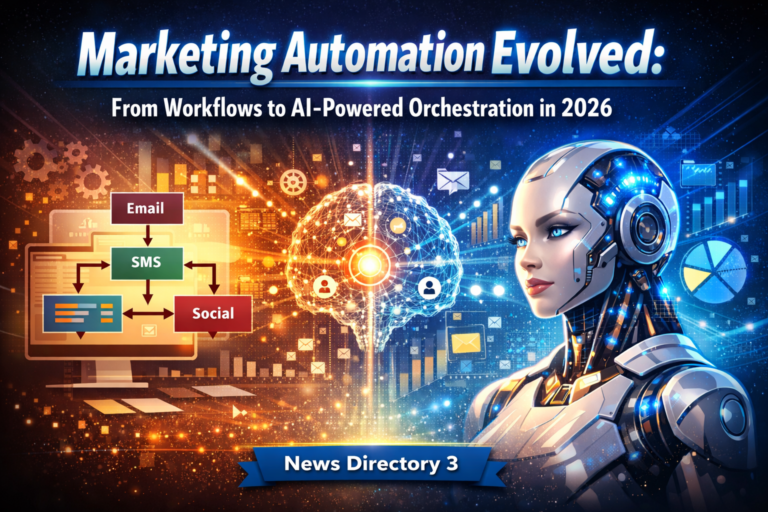
Marketing automation has gone through a fundamental shift. What started as simple rule-based workflows has now evolved into intelligent, adaptive systems powered by AI.
The difference is not incremental—it is structural.
Earlier, marketers defined every step of the journey. Today, AI dynamically shapes the journey based on user behavior, intent, and context.
If you want to understand how these systems are structured in practice, explore our Playbook.
The Limitations of Traditional Workflows
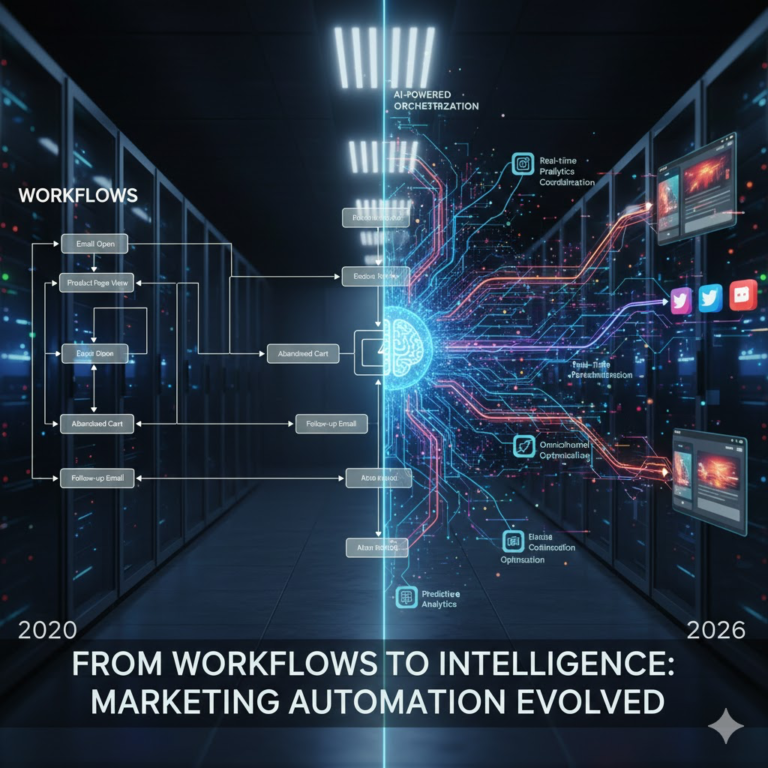
Traditional marketing automation worked on fixed logic: if a user performs action A, trigger action B.
While this was effective at the time, it had clear limitations.
Every path had to be predefined. Every scenario had to be manually mapped. And any deviation from expected behavior broke the flow.
This made systems rigid and difficult to scale.
As customer journeys became more complex, these limitations became more visible.
The Shift to AI-Powered Orchestration
AI removes the need for rigid workflows.
Instead of defining every step, you define the goal—and the system figures out the best path to achieve it.
This is what orchestration means.
AI continuously analyzes user behavior, engagement patterns, and contextual signals to decide what action to take next.
It is not following a script—it is making decisions in real time.
This makes marketing systems more flexible, adaptive, and effective.
Dynamic Funnels Instead of Fixed Paths
In traditional systems, funnels were linear.
Users moved from awareness to consideration to decision in a predefined sequence.
In reality, customer journeys are not linear.
AI-driven systems recognize this and adapt accordingly.
A user who shows high intent may skip multiple stages. Another user may need more nurturing before taking action.
Dynamic funnels adjust to these differences automatically.
To see how such systems are designed, visit our Home Page.
Real-Time Personalization at Scale
Personalization has always been important, but it was difficult to execute at scale.
AI solves this problem.
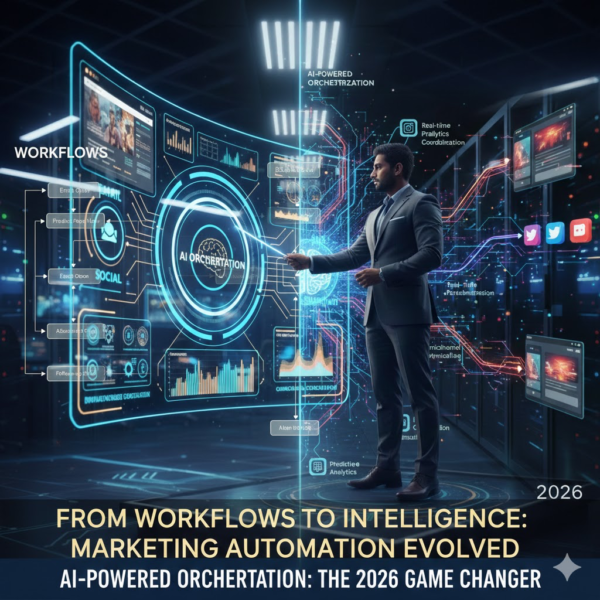
It analyzes data in real time and adjusts messaging, timing, and channel selection for each individual user.
This means two users visiting the same website may experience completely different journeys based on their behavior.
This level of personalization significantly improves engagement and conversion rates.
The Shift from Execution to Strategy
With AI handling execution, the role of marketers is changing.
Instead of managing workflows, marketers focus on defining strategy, setting goals, and creating high-quality content.
AI takes care of distribution, timing, and optimization.
This shift increases both efficiency and impact.
Learn more about how this integrates into business systems through our Services.
Challenges and Considerations
Despite its advantages, AI-powered marketing is not without challenges.
Data quality becomes critical. Poor data leads to poor decisions.
Privacy and compliance are also major concerns. Businesses must ensure that data is used responsibly and transparently.
There is also a learning curve. Teams need to understand how to work with AI systems effectively.
These challenges are manageable, but they require awareness and planning.
What This Means for Businesses
The shift to AI-powered orchestration is not optional—it is inevitable.
Businesses that adopt it early gain a significant advantage. They engage customers more effectively, optimize campaigns continuously, and scale faster.
Those who rely on outdated systems will struggle to compete.
Final Thoughts
Marketing is no longer about controlling every step of the process.
It is about setting clear objectives and allowing intelligent systems to execute dynamically.
AI does not remove the need for marketers—it elevates their role.
The future belongs to those who combine strategic thinking with intelligent systems.
If you want to build such systems for your business, explore our approach on the About Us page.